Showing posts with label breast cancer hospitals in india. Show all posts

Tuesday, 18 November 2014

Best Cancer Hospitals of India for Advanced Breast Cancer Treatment

Some Facts about Metastatic Breast Cancer

1. No one dies from breast cancer that remains in the breast. Metastasis occurs when cancerous cells travel to a vital organ and that is what threatens life.

2. Metastasis refers to the spread of cancer to different parts of the body, typically the bones, liver, lungs and brain.

3. An estimated 155,000 Americans are currently living with metastatic breast cancer. Metastatic breast cancer accounts for approximately 40,000 deaths annually in the U.S.

4. Treatment for metastatic breast cancer is lifelong and focuses on control of the disease and quality of life.

5. About 6% to 10% of people are Stage IV from their initial diagnosis.

6. Early detection does not guarantee a cure. Metastatic breast cancer can occur 5, 10 or 15 years after a person's original diagnosis and successful treatment checkups and annual mammograms.

7. 20% to 30% of people initially diagnosed with early stage disease will develop metastatic breast cancer.

8. Young people, as well as men, can be diagnosed with metastatic breast cancer.

9. Like early stage breast cancer, there are different types of metastatic breast cancer.

10. Treatment choices are guided by breast cancer type, location and extent of metastasis in the body, previous treatments and other factors.

11. Metastatic breast cancer is not an automatic death sentence. Although most people will ultimately die of their disease, some will live long and productive lives.

12. There are no definitive prognostic statistics for metastatic breast cancer. Every patient and their disease is unique.

Most Advanced Breast Cancer Care and Treatment in India - Best Cancer Hospitals of India for Advanced Breast Cancer Treatment

Medworld India offers comprehensive care for patients with Breast Cancer, including advanced diagnosis, best treatment options . A team of Surgical Oncologists, Radiation Oncologists, Medical Oncologists, Urologists, Rehabilitation team and other medical specialties work together to treat each Breast Cancer patient We consider each patient's type and extent of Breast Cancer to recommend the most appropriate treatment plan. They also carefully consider and select the treatment option that will allow the patient to maintain quality of life with good survival rate.

Why should you choose to get Indian hospitals offer the Best Cancer Treatment in India at affordable prices. MedWorld india associated Best Cancer Treatment Hospitals in India have the latest technology and infrastructure to offer the Most Advanced Cancer Treatment at low cost.

At MedWorld India Affiliated Best Cancer Hospitals are to deliver highest quality and advanced oncology care in a supportive and compassionate environment to all our patients, and to advance the treatment and prevention of cancers through innovative research.


·         World class results for Cancer Treatment
·         World Class equipment for investigations, radiotherapy and surgery
·         Cancer specialists with great qualifications and experience
·         India has many super specialists ( specialization in one particular area: Breast Cancers, Stomach Cancers, Prostate Cancers, etc)
·         Low cost of cancer treatment
·         India offers the perfect combination of expertise and economical costs

For more information visit:          http://www.medworldindia.com      
                    
https://www.facebook.com/medworld.india

Please scan and email your medical reports  to us at care@medworldindia.com and we shall get you a Free Medical Opinion from India’s Best Doctors.

Call Us : +91-9811058159
Mail Us : care@medworldindia.com

Friday, 26 September 2014

Low Cost Breast Cancer Treatment and Surgery in India : Surgery for Breast Cancer

Planning Treatment for Breast Cancer - Surgery for Breast Cancer

Surgery usually involves removing part, or sometimes all, of the breast (mastectomy). The type of operation you have usually depends on the size and position of the cancer. Your surgeon will recommend surgery that keeps as much of the breast tissue and the shape of the breast as possible. This is called breast-conserving surgery. However, in some situations removing all of the breast (mastectomy) is advised. Your doctor and breast care nurse will talk you through your options.
Your surgery may also involve having the lymph nodes in your armpit removed or you may have tests to check the nodes. Sometimes women are given treatment with hormonal therapy or chemotherapy to shrink the cancer before they have surgery.
In early breast cancer, studies show that removing the lump followed by radiotherapy is as effective as a mastectomy. Some women may be asked to choose for themselves which operation to have

·         Wide local excision (lumpectomy)
·         Mastectomy

Wide local excision (lumpectomy)

This is when the cancer and an area of surrounding tissue is removed. It’s called a wide local excision or lumpectomy. This operation removes the affected breast tissue and for most women the appearance of their breast after a lumpectomy is good.
If the lump is very small, a fine wire (guide wire) is used to mark the area to be removed so that the surgeon can find it more easily. The doctor or radiologist will inject some local anaesthetic into the area to numb it before inserting the wire, using x-ray or ultrasound to guide them. 
Occasionally, an operation called a quadrantectomy is done. This removes a larger area of breast tissue. The effect on the appearance of the breast will be more noticeable than after a lumpectomy. The treated breast will be smaller than your other breast and there may be a noticeable dent in it. Women can have surgery to reduce the size of the other breast (mammoplasty) so that both breasts are the same size. 
After these operations you’ll need to have radiotherapy to the remaining breast tissue to destroy any cancer cells that may have been left behind.  

Some women may need to have all of the breast removed (mastectomy). A mastectomy is usually advised if:
·         the lump is large in proportion to the rest of the breast
·         there are areas of cancer in different parts of the breast (multi-focal)
·         there’s widespread DCIS in the breast
·         you’ve previously had radiotherapy to the chest, for example, to treat Hodgkin lymphoma.

Mastectomy

Types of Mastectomy

A mastectomy removes all of the breast tissue. At the same time, you may have a test to check the lymph nodes in your armpit, or have some (or all) of the nodes removed.
A radicalmastectomy is where all the breast tissue, the muscles behind the breast and the lymph nodes in the armpit are removed. It’s only done if the cancer is found in the muscle under the breast. But this type of mastectomy is rarely needed as chemotherapy or hormonal therapy can usually be given before surgery to shrink the cancer. This means a mastectomy that removes only the breast tissue can then be done. 


Breastreconstruction

If you’re having a mastectomy, you’ll usually be offered breast reconstruction at the same time. This is when a new breast shape is formed. Breast reconstruction is very specialised surgery. Surgeons who do this type of operation may be plastic surgeons or oncoplastic surgeons, who are trained in both breast cancer surgery and reconstruction surgery.

Different techniques are used – for example, muscle from the back or the tummy area, or a silicone implant can be used. Some women may decide not to have it done immediately – it can be done months or even years after a mastectomy.

Medworld India offers comprehensive care for patients with Breast Cancer, including advanced diagnosis, best treatment options . A team of Surgical Oncologists, Radiation Oncologists, Medical Oncologists, Urologists, Rehabilitation team and other medical specialties work together to treat each Breast Cancer patient We consider each patient's type and extent of Breast Cancer to recommend the most appropriate treatment plan. They also carefully consider and select the treatment option that will allow the patient to maintain quality of life with good survival rate.

Why should you choose to get Indian hospitals offer the Best Cancer Treatment in India at affordable prices. MedWorld india associated Best Cancer Treatment Hospitals in India have the latest technology and infrastructure to offer the Most Advanced Cancer Treatment at low cost.;

At MedWorld India Affiliated Best Cancer Hospitals are to deliver highest quality and advanced oncology care in a supportive and compassionate environment to all our patients, and to advance the treatment and prevention of cancers through innovative research.

MedWorld India Affiliated Best Cancer Hospitals in India offer:

·         World class results for Cancer Treatment
·         World Class equipment for investigations, radiotherapy and surgery
·         Cancer specialists with great qualifications and experience
·         India has many super specialists ( specialization in one particular area: Breast Cancers, Stomach Cancers, Prostate Cancers, etc)
·         Low cost of cancer treatment
·         India offers the perfect combination of expertise and economical costs
 
 For more information visit:          http://www.medworldindia.com     
                                                          
https://www.facebook.com/medworld.india
Please scan and email your medical reports  to us at care@medworldindia.com and we shall get you a Free Medical Opinion from India’s Best Doctors.
·          
·         Call Us : +91-9811058159
·         Mail Us : care@medworldindia.com
·          

Friday, 29 August 2014

Effective Radiation Therapy for the Treatment of Breast Cancer

Most women who have been diagnosed with breast cancer will undergo some form of treatment for the disease. The most favorable course of treatment will depend on a number of factors, including the size and location of the breast tumor, the stage of the cancer, and results of other laboratory tests. This section provides information on the treatment options for breast cancer, discusses how to cope with the side effects of treatment, and addresses important aspects to consider before and after breast cancer treatment.

Radiation therapy (or radiotherapy) uses high-energy rays to stop cancer cells from growing and dividing. Radiation therapy is often used to destroy any remaining breast cancer cells in the breast, chest wall, or axilla (underarm) area after surgery. Occasionally, radiation therapy is used before surgery to shrink the size of a tumor. A common treatment for early stage breast cancer is breast-conserving therapy. Breast-conserving therapy (BCT) is the surgical removal of a breast lump (lumpectomy) and a surrounding margin of normal breast tissue. BCT is typically followed by at least six to seven weeks of radiation therapy. 

Treatment with radiation usually begins one month after surgery, allowing the breast tissue adequate time to heal. Radiation therapy may occasionally be recommended for women to destroy remaining cancer cells after mastectomy (surgical removal of the affected breast) or to shrink tumors in patients with advanced breast cancer.

External Beam Radiation

The most common type of radiation therapy used on women with breast cancer is called external beam radiation. External beam radiation is delivered from a source outside the body on the specific area of the body that has been affected by the cancer. Experts compare the experience of external beam radiation to having a diagnostic x-ray, except that radiation is usually administered for a longer period of time and at a higher dose.

Before radiation therapy begins, the physician will measure the correct angles for aiming the radiation beam at the specific area of the body and make ink marks on the patient̢۪s skin. As part of treatment after breast surgery, patients are typically treated with radiation five times per week for at least six weeks in an outpatient clinical setting. Each treatment generally lasts a few minutes; the entire radiation session after machine set-up typically lasts 15 to 30 minutes. The procedure itself is pain-free. While the radiation is being administered, the technologist will leave the room and monitor the patient on a closed-circuit television. However, patients should be able to communicate with the technologist at any time over an intercom system.

Side effects of external beam therapy vary among patients. The most common side effect is fatigue. Fatigue (extreme tiredness) can be especially bothersome in the later weeks of treatment. Patients who experience fatigue after radiation sessions should get plenty of rest and try to maintain an active lifestyle. While many patients can still work and participate in normal activities during radiation therapy, some patients find it necessary to limit their work or activities until treatment has been completed.

Other common side effects of radiation therapy are neutropenia (sharp decrease in white blood cell count) swelling of the breast, a feeling of heaviness in the breast, a sunburn-type appearance of the breast skin, and loss of appetite. These side effects usually disappear after six to 12 months. Near the end of treatment with radiation, the breast skin may become moist. Patients should try to wearing loose fitting clothing and expose the skin to air as much as possible to help the skin heal quickly.


Temporary Side Effects of Radiation Therapy
  • Fatigue
  • Neutropenia (reduction in white blood cells)
  • Breast swelling or tenderness
  • Feeling of heaviness in the breast
  • Sunburn-like appearance of the breast skin
  • Loss of appetite

In most cases, the breast will look and feel the same after radiation therapy is completed, though it may be more firm. In rare cases, radiation therapy may cause changes in the breast size. Breasts may become larger due to fluid build-up (seroma) or smaller due to tissue changes. Some women may find that the breast skin is more sensitive after radiation, while others may find that it is less sensitive. Radiation therapy of the axillary (underarm) lymph nodes may cause lymphedema (chronic swelling of the arm) in some women. Women who have radiation to the lymph nodes will usually be instructed on arm exercises and other activities to help prevent lymphedema.


For more information visit:          http://www.medworldindia.com        
                    
https://www.facebook.com/medworld.india

Please scan and email your medical reports  to us at care@medworldindia.com and we shall get you a Free Medical Opinion from India’s Best Doctors.

Call Us : +91-9811058159

Mail Us : care@medworldindia.com

Saturday, 23 August 2014

Breast Cancer Treatment at World Best Cancer Hospitals in India : Surgery, Chemotherapy, Radiation Therapy and Hormonal Therapy


Breast cancer is not one single disease. There are several types of breast cancer. It can be diagnosed at different stages of development and can grow at different rates. . You may need help to get the facts straight and to ask the questions that are important to you.If you have any questions, please remember that we offer a range of services for people affected by breast cancer. 

From diagnosis, through treatment and beyond, our services are here every step of the way. The most common sign of breast cancer is a new lump or a mass. A lump that is painless hard and has uneven edges is likely to be cancer. But some cancer are soft, tender and rounded. All Breast lump are not cancerous, in fact most are benign. However each has to be analyzed and tested as some benign lumps can increase your risk. So its important to have anything unusual checked by your doctor.

Other Signs of Breast Cancer:
  • A Swelling of a part of a breast
  • Skin irritation or dimpling in the breast area
  • Unusual Nipple pain or the nipple turning inward
  • Redness or scaliness of the nipples or breast skin
  • A Nipple discharge other than breast milk

There are several modalities of the treatment-these include Surgery, Chemotherapy, Radiation Therapy and Hormonal Therapy. These are usually used in a combination.

1) Surgery

A) Breast Conservation Surgery: Wide excision of only the Breast Lump (saving the normal breast) with removal of axillary nodes. At the end of the procedure ,you have a near normal breast.

B) Modified Radical Mastectomy (MRM): This surgery involves the removal of entire breast and axillary lymph nodes. This surgery is recommended in the following circumstances:-
  • Cancer is found in more than one part of the breast
  • Breast is so small that wide excision of the lump can severely deform the breast
Following the surgery a drain is placed in the axilla and another drain is placed under the flaps after the Mastectomy. This will be removed in another 7-14 days depending on the amount of the fluid that is draining out. Stitches are removed two weeks after the surgery.
C) Modified Radical Mastectomy with Reconstruction: For those women who are unhappy with the idea of losing their breast and are suitable for immediate breast reconstruction can choose this option. A plastic surgeon is involved in this surgery and utilizes patient's own tissues to create a breast which closely matches the opposite breast, if required an artificial implant may also be use.
2) Chemotherapy
Many Patients may require Chemotherapy after the Breast Cancer Surgery. In Chemotherapy a combination of the drugs is used to kill the cancer cells. The medical oncologist will plan the therapy according to the individual case. Chemotherapy may be administered as Neoadjuvant,Adjuvant and Palliative chemotherapy.

3) Radiation Therapy
Breast Conservation Surgery is always followed by Radiation Therapy. It may also be used after Mastectomy surgery if required. The radiation therapy uses very high energy X-rays to destroy the cancer cells that still may be present in the affected breast or nearby lymph node. This procedure is painless and the patient does not feel anything when the treatment is going on.


4) Hormonal Therapy
Hormonal therapy medicines are whole-body (systemic) treatment for hormone-receptor-positive breast cancers. Hormone receptors are like ears on breast cells that listen to signals from hormones. These signals "turn on" growth in cells that have receptors. Hormonal therapy medicines can be used to lower the risk of early-stage hormone-receptor-positive breast cancer coming back, lower the risk of hormone-receptor-positive breast cancer in women who are at high risk but haven't been diagnosed with breast cancer and help shrink or slow the growth of advanced-stage or metastatic hormone-receptor-positive breast cancers

For more information visit:          http://www.medworldindia.com        
                    
https://www.facebook.com/medworld.india

Please scan and email your medical reports  to us at care@medworldindia.com and we shall get you a Free Medical Opinion from India’s Best Doctors.

Call Us : +91-9811058159
Mail Us : care@medworldindia.com
Wednesday, 6 August 2014

Types of Surgery for Breast Cancer in India : Breast Conserving Surgery

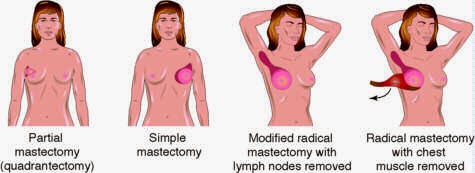
Most women with breast cancer have some type of surgery. Surgery is often needed to remove a breast tumor. Options for this include breast-conserving surgery and mastectomy. The breast can be reconstructed at the same time as surgery or later on. Surgery is also used to check the lymph nodes under the arm for cancer spread. Options for this include a sentinel lymph node biopsy and an axillary (armpit) lymph node dissection.

Surgery for breast cancer Surgery usually involves removing part, or sometimes all, of the breast (mastectomy). The type of operation you have usually depends on the size and position of the cancer. Your surgeon will recommend surgery that keeps as much of the breast tissue and the shape of the breast as possible. This is called breast-conserving surgery. However, in some situations removing all of the breast (mastectomy) is advised. Your doctor and breast care nurse will talk you through your options.
Your surgery may also involve having the lymph nodes in your armpit removed or you may have tests to check the nodes. Sometimes women are given treatment with hormonal therapy or chemotherapy to shrink the cancer before they have surgery.
In early breast cancer, studies show that removing the lump followed by radiotherapy is as effective as a mastectomy. Some women may be asked to choose for themselves which operation to have

  •     Wide local excision (lumpectomy)
  •     Mastectomy
  •     Wide local excision (lumpectomy)


This is when the cancer and an area of surrounding tissue is removed. It’s called a wide local excision or lumpectomy. This operation removes the affected breast tissue and for most women the appearance of their breast after a lumpectomy is good.
If the lump is very small, a fine wire (guide wire) is used to mark the area to be removed so that the surgeon can find it more easily. The doctor or radiologist will inject some local anaesthetic into the area to numb it before inserting the wire, using x-ray or ultrasound to guide them. 
Occasionally, an operation called a quadrantectomy is done. This removes a larger area of breast tissue. The effect on the appearance of the breast will be more noticeable than after a lumpectomy. The treated breast will be smaller than your other breast and there may be a noticeable dent in it. Women can have surgery to reduce the size of the other breast (mammoplasty) so that both breasts are the same size. 
After these operations you’ll need to have radiotherapy to the remaining breast tissue to destroy any cancer cells that may have been left behind.  

Some women may need to have all of the breast removed (mastectomy). A mastectomy is usually advised if:
·         the lump is large in proportion to the rest of the breast
·         there are areas of cancer in different parts of the breast (multi-focal)
·         there’s widespread DCIS in the breast
·         you’ve previously had radiotherapy to the chest, for example, to treat Hodgkin lymphoma.


Mastectomy

Types of Mastectomy

A mastectomy removes all of the breast tissue. At the same time, you may have a test to check the lymph nodes in your armpit, or have some (or all) of the nodes removed.
A radicalmastectomy is where all the breast tissue, the muscles behind the breast and the lymph nodes in the armpit are removed. It’s only done if the cancer is found in the muscle under the breast. But this type of mastectomy is rarely needed as chemotherapy or hormonal therapy can usually be given before surgery to shrink the cancer. This means a mastectomy that removes only the breast tissue can then be done. 


Breastreconstruction

If you’re having a mastectomy, you’ll usually be offered breast reconstruction at the same time. This is when a new breast shape is formed. Breast reconstruction is very specialised surgery. Surgeons who do this type of operation may be plastic surgeons or oncoplastic surgeons, who are trained in both breast cancer surgery and reconstruction surgery.

Different techniques are used – for example, muscle from the back or the tummy area, or a silicone implant can be used. Some women may decide not to have it done immediately – it can be done months or even years after a mastectomy.

Medworld India offers comprehensive care for patients with Breast Cancer, including advanced diagnosis, best treatment options . A team of Surgical Oncologists, Radiation Oncologists, Medical Oncologists, Urologists, Rehabilitation team and other medical specialties work together to treat each Breast Cancer patient We consider each patient's type and extent of Breast Cancer to recommend the most appropriate treatment plan. They also carefully consider and select the treatment option that will allow the patient to maintain quality of life with good survival rate.

Why should you choose to get Indian hospitals offer the Best Cancer Treatment in India at affordable prices. MedWorld india associated Best Cancer Treatment Hospitals in India have the latest technology and infrastructure to offer the Most Advanced Cancer Treatment at low cost.;

At MedWorld India Affiliated Best Cancer Hospitals are to deliver highest quality and advanced oncology care in a supportive and compassionate environment to all our patients, and to advance the treatment and prevention of cancers through innovative research.

MedWorld India Affiliated Best Cancer Hospitals in India offer:

·         World class results for Cancer Treatment
·         World Class equipment for investigations, radiotherapy and surgery
·         Cancer specialists with great qualifications and experience
·         India has many super specialists ( specialization in one particular area: Breast Cancers, Stomach Cancers, Prostate Cancers, etc)
·         Low cost of cancer treatment
·         India offers the perfect combination of expertise and economical costs

For more information visit:          http://www.medworldindia.com        
                    
https://www.facebook.com/medworld.india

Please scan and email your medical reports  to us at care@medworldindia.com and we shall get you a Free Medical Opinion from India’s Best Doctors.

Call Us : +91-9811058159
Mail Us : care@medworldindia.com

Contact Form

Name

Email *

Message *